10 mins read
Are Teachers Right to Be Cautious About AI in Education?
The national debate on AI in education is missing a critical distinction: the difference between general-purpose AI and tools built specifically for the classroom.
10 mins read
Are Teachers Right to Be Cautious About AI in Education?
The national debate on AI in education is missing a critical distinction: the difference between general-purpose AI and tools built specifically for the classroom.


It's 9 pm.
You're still planning.
Not because you want to be, but because lessons need to be differentiated. Outcomes need to be aligned. Assessments need to be valid and meaningful. And somehow, all of that has to fit into an already full day.
You're not alone.
Planning is consistently identified as the most time-consuming part of teaching and one of the most significant pressures on the profession. At the same time, expectations continue to rise in personalised learning, outcomes-based education, and continuous assessment.
The system has changed. The infrastructure to support it hasn't.
Into that gap, artificial intelligence has arrived and with it, a national conversation about what role it should play in Irish education. It is a conversation happening in staffrooms, at conference podiums, in national newspapers, and at kitchen tables. And at its core, the question is simple: will AI help teachers, or will it make everything harder?
Based on the evidence, both answers are correct, but it depends entirely on what kind of AI we are talking about.
Teachers Want to Learn More, but They Also Want Safeguards
In 2024, the Association of Secondary Teachers in Ireland published the findings of its RED C survey on digital technology and teachers' working lives. The results will be familiar to anyone who has spent time in a staffroom.
Around a third of teachers reported using AI in their planning and preparation, and just over a fifth were using it in the classroom. Strikingly, 91% said they wanted to know more about AI and education. Curiosity is real.
But so is the concern. More than 80% of teachers raised issues around data harvesting, the risk that AI could undermine professional teacher autonomy, and, perhaps most telling, the possibility that it might increase their workload rather than reduce it.
That last point is worth sitting with. Teachers are not opposed to technology; they are one of the early adopters, with around two-thirds already using it to plan their classes. They are opposed to technology that makes their day longer, their planning more fragmented, and their professional judgment less central. They are concerned about how student data is handled. They are thinking about what it means for how their students learn, not just today, but in the years ahead.
These are distinct concerns, and they deserve to be treated as such. Too often, the conversation about AI in education collapses everything from workload, privacy, pedagogy, and assessment integrity under a single umbrella. But these are different questions, with different answers. And until we start addressing them individually, the debate will continue to generate more noise than clarity.
The Problem Didn't Start With AI
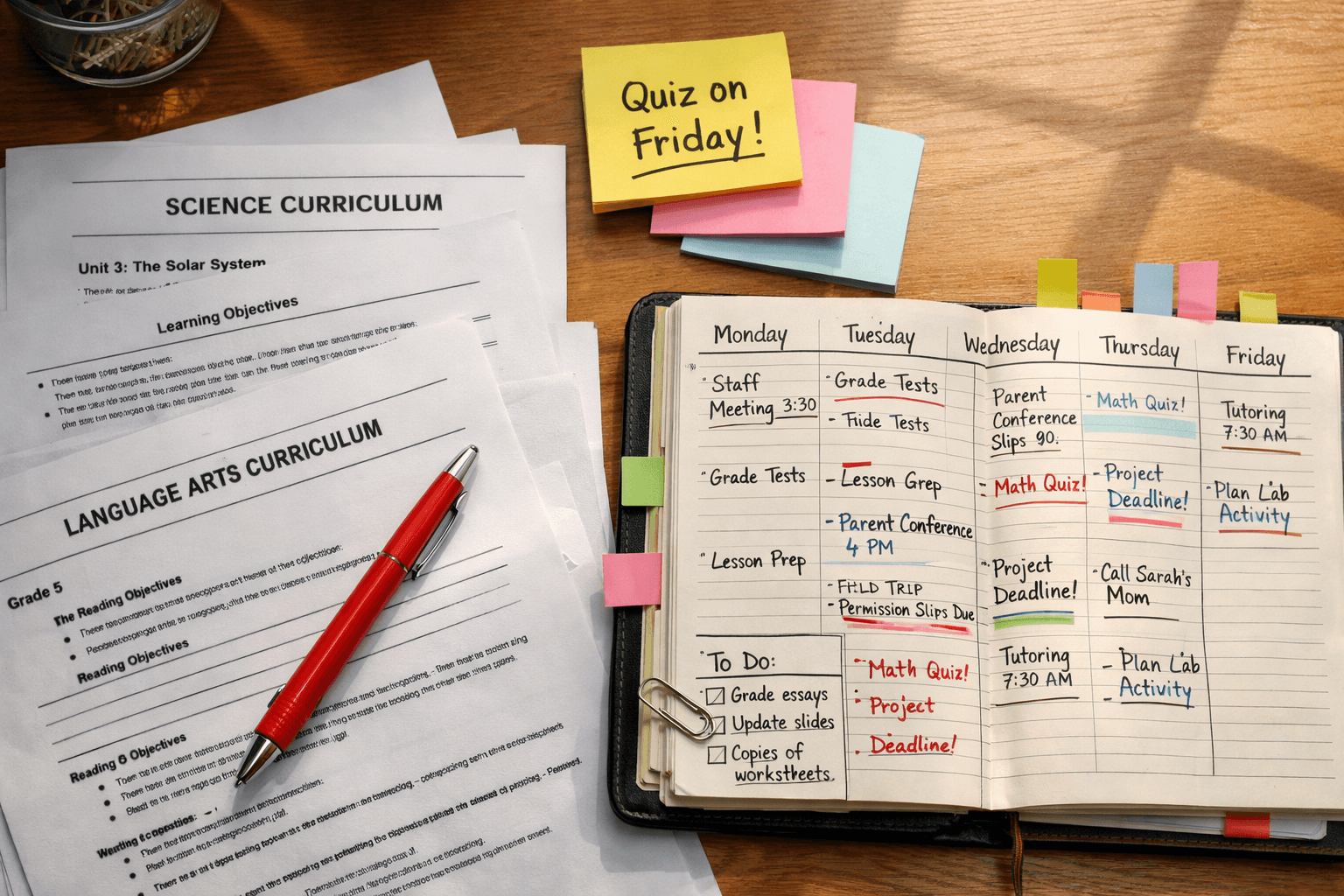
The workload crisis predates any conversation about artificial intelligence.
Over the past decade, international education systems have raised expectations around planning, assessment, differentiated learning, and curriculum alignment. In Ireland, the shift towards more teacher agency and student-centred learning has sound pedagogical goals. But they have been introduced without providing the tools or time to deliver them.
Teachers have absorbed the gap. Planning that should happen during the working day gets pushed into evenings and weekends. Administrative tasks expand to fill time that does not exist. And the work that drew most people into teaching, like engaging with students, is increasingly squeezed by everything that surrounds it.
This is the structural reality into which all new technology arrives. It explains why teachers' response to AI is simultaneously hopeful and wary. The promise is that it could ease this burden. The fear is that it will add another layer of complexity to an already stretched profession.
The Distinction
In recent weeks, the conversation has sharpened. A prominent piece in the Irish Times argued that AI is a threat to the essence of education. The OECD's Digital Education Outlook report puts it plainly: an overreliance on AI risks "turning students into passive consumers and teachers into supervisors." Teachers' unions have raised pointed questions about how AI-generated work will be authenticated under the new Leaving Certificate Additional Assessment Components, with 88% of surveyed ASTI members saying these assessments will create difficulties in this area.
But much of the debate treats AI as a single, monolithic category, as though a teacher asking ChatGPT for lesson ideas and a student using it to write an essay are the same thing. They are not, and the truth is, this debate is much deeper. Until we start making these distinctions, the conversation will remain a mile wide and an inch deep. This blog intends to do that. We will take these issues over the coming months and explore each in depth.
The Problem with Generic AI in Education
General-purpose AI tools like ChatGPT are impressive. They can generate lesson plans, suggest assessment ideas, draft student resources, and answer pedagogical questions with remarkable fluency. Teachers are resourceful, and many have found creative ways to put these tools to work.
But generic tools carry inherent limitations in an educational context. They don't seem to understand the structure of the Irish curriculum. They cannot reliably map a learning outcome to the relevant specification. They do not know how a Junior Cycle assessment standard connects to a particular strand or element.
When teachers use generic tools, they take on additional cognitive work to check, adapt, and align the output. In many cases, this adds time rather than saving it, which is precisely the concern the ASTI's survey identified.
It also connects to the issue of teacher autonomy and agency. When a teacher uses a generic tool, they become responsible for quality-assuring output that may look authoritative but may not be pedagogically sound. The teacher is not supported by the technology. They are supervising it. This is a meaningful difference and one that echoes the OECD's warning about teachers becoming “supervisors” rather than what we should be developing: teachers as professional agents who autonomously work with AI.

What the Alternative Looks Like
The alternative is still emerging, but it needs to be a human-centric approach to AI, built from the ground up around a specific educational context. Tools that understand the curriculum natively, that are designed around the teacher's actual workflow, and that treat the teacher as the decision-maker rather than the prompt engineer.
In practical terms, this looks quite different from the generic experience. Rather than asking a teacher to describe what they need in a text prompt and then evaluate whether the output meets the relevant standards, learning outcomes, and assessment expectations, a curriculum-specific tool already knows these standards, learning outcomes, and assessment expectations. The teacher's role shifts from quality-assuring generic output to making professional choices within a framework that is already aligned.
This distinction matters for each of the three concerns teachers have raised most consistently.
On data privacy, purpose-built educational tools can be designed within GDPR-compliant frameworks from the outset, rather than relying on the privacy policies of large consumer technology platforms whose primary markets are not education.
On professional autonomy, curriculum-specific tools can be structured so that the teacher's judgment remains central. AI generates options and structures; teachers choose, adapt, and own the result. This is the opposite of the supervisory role the OECD report warned about.
And on workload, the 9 pm problem, the core promise of purpose-built tools is that they absorb the infrastructure gap the system has created. When AI handles the alignment and structuring work that currently consumes evenings and weekends, it is not adding another tool to manage. It is providing the planning infrastructure that should have existed long before AI entered the conversation.
A Straightforward Piece of Logic
International research has already demonstrated that teachers who use generic AI tools report meaningful time savings. Studies by the Walton Family Foundation in the United States have consistently documented this. Teachers are adaptive; give them any tools and they will find a way to make it useful.
But the logic that follows is important, and it is the piece most often missing from the national debate: if generic tools that were never designed for education can already save teachers significant time, then tools specifically built for a curriculum, an assessment framework, and a planning workflow should deliver even greater benefit. And they should do so without the alignment risks, the prompt engineering burden, and the data concerns that come with repurposing general-purpose technology for the classroom.
This is not an argument against AI in education. Nor is it an argument against generic tools; they have their uses, and many teachers will continue to find value in them. It is an argument for precision. For recognising that the question is not whether AI belongs in education, but what kind of AI, built by whom, for what purpose, and with what safeguards.

The Decisions That Matter Now
We are at an early but decisive moment. The Department of Education's guidance acknowledges that AI is a rapidly evolving area and that its benefits in education are still being evaluated. The ASTI and TUI are rightly pressing for adequate professional time and clear guidance. The European Commission and the OECD are developing AI literacy frameworks that will inform international assessments such as PISA 2029. And teachers themselves are telling us that they want tools that work for them, not tools they have to work around.
The decisions made now about how AI is introduced into Irish education will shape classroom practice for years to come. If the conversation remains stuck in a binary
AI is either a saviour or a threat; we will miss the opportunity to build something genuinely useful.
Other countries are not waiting. In the UK, the government has invested over £40 million in Oak National Academy, a publicly funded curriculum body that provides free, curriculum-aligned resources and AI-powered planning tools built specifically around the English national curriculum. The Education Endowment Foundation is running a rigorous trial to evaluate the impact of Oak's AI lesson assistant, and early evidence suggests that teachers using Oak's resources work nearly five fewer hours per week. This is not a speculative pilot. It is national infrastructure, built on the principle that teachers deserve tools designed for their curriculum, not adapted from generic technology. And Oak’s planning tool is just the tip of the iceberg in terms of what can be achieved.
Ireland faces the same workload pressures. Irish teachers have raised the same concerns about autonomy, data, and time. But we do not yet have an equivalent national commitment to building curriculum-specific AI infrastructure for our classrooms. The question is whether we will.
Teachers have always been expected to do more with less. For once, technology exists to change that equation
Chris Byrne




Become a MESO Fellow
Want to get involved? Become a global voice for MESO Lab and have your say on how we build and deliver tools for teachers. Join our community of education innovators as a MESO Fellow. We are seeking teachers and researchers with diverse expertise across educational disciplines and curricular backgrounds to help shape the future of educational planning tools.
Become a MESO Fellow
Want to get involved? Become a global voice for MESO Lab and have your say on how we build and deliver tools for teachers. Join our community of education innovators as a MESO Fellow. We are seeking teachers and researchers with diverse expertise across educational disciplines and curricular backgrounds to help shape the future of educational planning tools.
Become a MESO Fellow
Want to get involved? Become a global voice for MESO Lab and have your say on how we build and deliver tools for teachers. Join our community of education innovators as a MESO Fellow. We are seeking teachers and researchers with diverse expertise across educational disciplines and curricular backgrounds to help shape the future of educational planning tools.